The AI ops layer
for product‑led
SaaS.
From inbound signal to closed case — automatically. NestFleet triages, routes, replies, and drafts changes across every channel, so your team ships instead of triages.
NestFleet sits silently inside your SDLC — no new processes to learn, no heavy tooling to adopt. It captures every signal, keeps your backlog clean, and reduces the human overhead that slows software teams down. Better products, faster releases, lower operational cost.
Export pipeline keeps failing with timeout
Hi, I've been trying to export my document collection for the past 2 hours...
HOW IT WORKS
From inbox to resolved in seconds.
Four autonomous steps. Zero context switching.
Every inbound captured instantly
Email, webhooks, Telegram — NestFleet ingests every signal the moment it arrives. No polling, no missed messages, no manual intake.
- Email webhooks with full threading support
- GitHub issues and PR events
- Instant case creation with deduplication
From: [email protected]
Export pipeline keeps timing out
"Hi, I've been trying to export 847 documents for 2 hours and it keeps failing with a timeout after ~5 minutes. This is blocking our end-of-quarter report..."
FULL TRACEABILITY
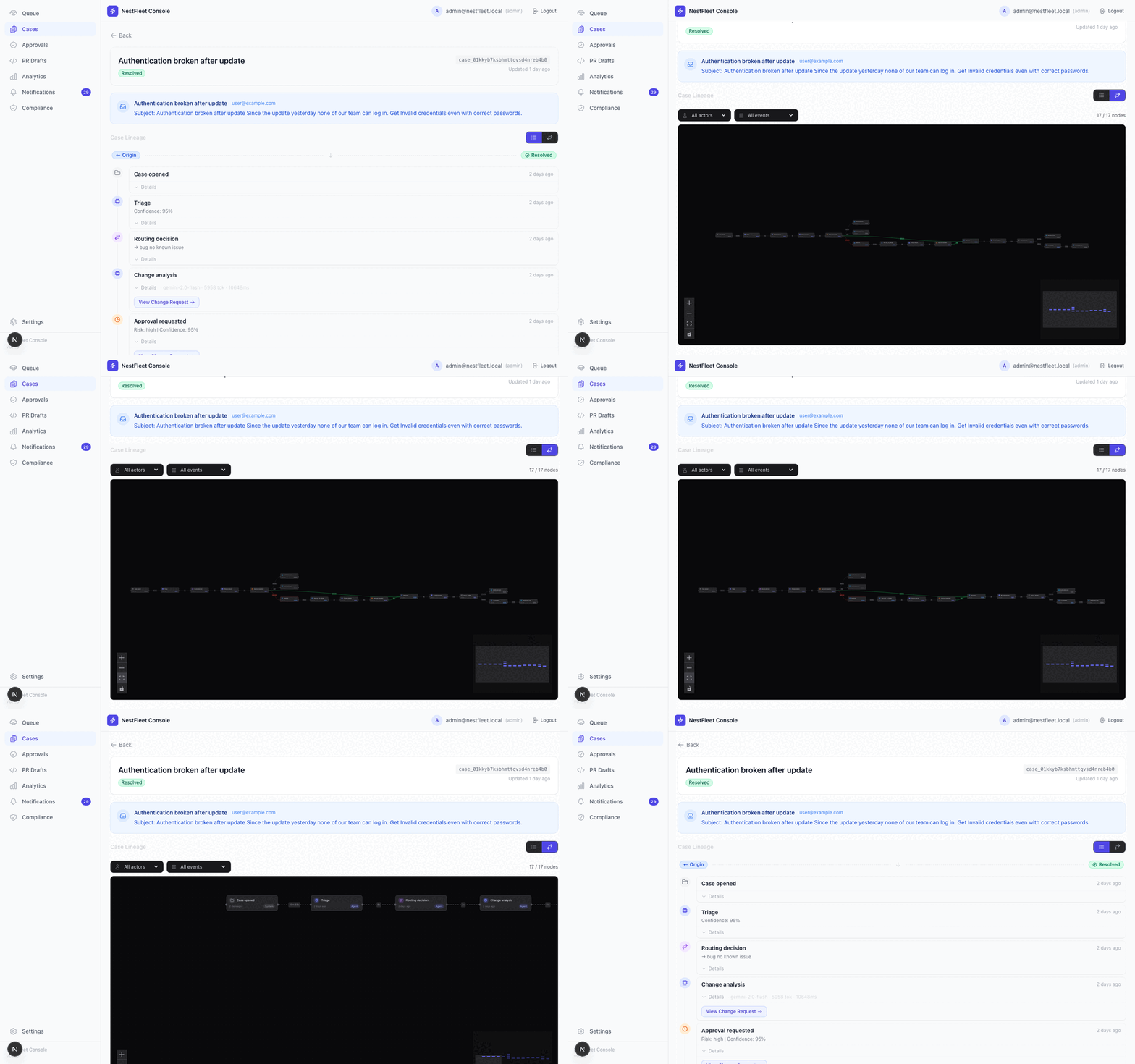
See the full lineage from signal to resolution.
Every decision logged. Every action traced. Interactive graph view with clickable nodes — drill into any step of the case lifecycle.
OMNI-CHANNEL
Every channel. One brain.
Wherever your users reach you — email, Telegram, GitHub — NestFleet is already listening. Every signal is normalized, triaged, and acted on. Nothing slips through the cracks.
Signals In
Support requests, bug reports, questions
Telegram
Async updates, founder & team channels
GitHub
Issues, PR events, webhooks
Webhooks
Any internal system or third-party tool
NestFleet
Actions Out
Email reply
Workarounds, status, resolution
Telegram
Approval requests, escalations, digests
GitHub PR / Issues
Drafted artifacts, linked changes
Notifications
Leads alerted at every decision gate
Zero missed signals
Every channel feeds the same AI engine
Fast to market
Bug → change request → PR in minutes, not sprints
Continuously improving
Every resolved case enriches your knowledge base
High-quality products
Systemic issues surface before they accumulate
Notification control plane — built in, not bolted on
Priority queues, quiet hours, ack deadlines, and escalation chains are first-class features. Critical alerts bypass quiet hours. Digest summaries keep leads informed without pager fatigue. Notifications are operational control signals — not cosmetic UI noise.
ROLES & AGENTS
Your team + AI agents, working together.
Six human roles with granular permissions. Three AI agents that handle the work. One founder can hold all roles — or split them across your team.
Your team — 6 roles, granular permissions
Administrator
adminFull platform management — users, settings, license, integrations
Operator
operatorDay-to-day console — views cases, drafts clarifications, monitors notifications
Support Lead
support_leadOwns the case lifecycle — triage, resolve, escalate, approve communications
Change Lead
change_leadReviews change requests, approves or rejects, completes PR drafts
Product Lead
product_leadApproves high-impact changes, sets priorities, triages escalations
Knowledge Lead
knowledge_leadManages product memory — docs, FAQs, runbooks, knowledge quality
Feature access by role
| Role | Cases | Queue | PR Drafts | Notifications | Analytics | Settings | Users |
|---|---|---|---|---|---|---|---|
🛡️Administrator | |||||||
🖥️Operator | — | — | |||||
💬Support Lead | — | — | — | — | |||
⚙️Change Lead | — | — | — | ||||
🎯Product Lead | — | — | — | ||||
📚Knowledge Lead | — | — | — | — | — |
AI Agents — autonomous background workers
Frontline Agent
Intake & enrichmentIngests signals, normalizes conversations, asks clarifying questions, routes to triage
Steward Agent
Triage & routingClassifies severity and type, matches known issues, decides auto-resolve vs escalate
Change Agent
Engineering & PR draftingCreates change requests, drafts GitHub PRs, links signals to code changes
Agents propose actions. Humans approve consequential decisions. Every action is typed, validated, and auditable.
Solo founder? One person holds all six roles. Growing team? Split them — no platform reconfiguration.
FEATURES
Built for teams that move fast.
Every feature exists to reduce toil, not add it.
Instant AI Triage
Every signal classified in under 2 seconds — severity, type, labels, confidence, routing team. No queue saturation. No human bottleneck.
Known Issue Matching
Vector similarity search against your runbooks, FAQs, and past cases. Tier-ranked results feed the auto-reply or routing decision directly.
Autonomous Auto-Reply
High-confidence cases resolved with a workaround or documentation link — drafted, sent, and closed. No human in the loop required.
AI Change Management
Novel bugs go from report to risk-assessed change request in one agent step. Affected surfaces, recommended approver, GitHub PR artifact — all structured.
Living Knowledge Base
Every resolved case automatically proposes FAQ entries, known-issue records, and runbook updates. Your product gets smarter with every closed ticket.
Governed Automation
T0–T5 action tiers with schema validation, policy engine, and secondary validator on every proposal. Abstain-and-escalate when confidence is low. No black-box commits.
Analytics & Cost Control
Real-time dashboard with token costs per model, agent success rates, case resolution trends, and operational metrics. Know your automation ROI at a glance.
Approval Workflows
Change requests routed to the right lead with full context. Approve or reject with rationale. Rejection notifies support. Full audit trail for compliance.
Team & Roles
Six built-in roles — Admin, Operator, Support Lead, Change Lead, Product Lead, Knowledge Lead. Granular permissions per feature. Compose roles per team size.
INTEGRATIONS
Works with your stack.
Connect the tools your team already uses. Connector-based — each product enables only what it actually needs.
Engineering
GitHub
LiveIssues, PR drafts, webhooks
CI Webhooks
LivePR merge → CI status → deploy tracking
Communication
Inbound + outbound via any SMTP / Postmark
Telegram
LiveTeam channels and async updates
Slack
SoonAlerts, approvals, digest delivery
Work management
Jira
SoonIssues, sprints, project sync
Asana
SoonTasks, projects, team workspaces
Linear
SoonIssues, cycles, roadmap sync
Knowledge
Confluence
SoonDocs, runbooks, knowledge base
Notion
SoonPages, wikis, project docs
Connector-based architecture — each product enables only what it needs. No bloatware. Request an integration →
SELF-HOSTED
Privacy-first by architecture, not by promise.
Customer data never reaches our infrastructure. You control every byte.
Your infrastructure
Deploy on Kubernetes, Docker, or bare metal. Your PostgreSQL, your object storage, your rules.
Your LLM credentials
Bring your own API keys — OpenAI, Anthropic, Gemini, or self-hosted Ollama. We never proxy your calls.
Your retention policy
Configure per-product retention windows. Auto-delete after N days. GDPR Art. 17 erasure built in.
Zero cloud lock-in
No external dependencies — runs fully air-gapped if needed. No telemetry, no phone-home, no vendor lock-in. Your data never leaves your infra.
GDPR-ready · SOC 2-compatible architecture · No per-seat pricing · AGPL-3.0 open source
< 2s
Average triage time
AGPL
Open source, always
100%
Audit trail coverage
0
Missed signals
TRUST & COMPLIANCE
Built for regulated teams.
GDPR, EU AI Act, data sovereignty, and full auditability — not as add-ons, but as architectural decisions made at the start.
GDPR
Article 22 compliant
EU AI Act
Transparency & human oversight
Data Sovereignty
Your infra, your data
NIS-2 Ready
Incident logging foundation
CRA Ready
SBOM & secure updates
BSL Source
Fully auditable codebase
Data never leaves your infrastructure
NestFleet is client-installed. All signals, cases, change requests, and audit logs stay in your PostgreSQL database. The cloud connection sends zero customer content — only aggregate usage counts and error type codes.
Every AI decision is traceable
No opaque black-box outputs. Every agent action is a typed, schema-validated proposal backed by evidence references. The audit trail records the model, prompt inputs, output validation result, and human decision point — suitable for DPIA and regulatory investigation.
Lightweight legal footprint
NestFleet operates as a software vendor, not a data processor. Your DPA scope is limited to cloud-connection metadata only. You control your own LLM vendor relationship and compliance posture. Compliance template bundles (DPIA, privacy notices, AI disclosure) are delivered via cloud update.
Hard boundaries on consequential decisions
NestFleet is policy-prohibited from automated decisions with legal or significant personal effect. No HR, credit, insurance, law-enforcement, or welfare workflows. All high-impact actions require human approval. The forbidden-action list is code-enforced, not just documented.
Business Source License — inspect before you deploy
NestFleet's full source code is readable for security audit and review. Production use requires an active subscription. The license converts to full open source after 3–4 years. No hidden behaviour. No surprise changes. You can see exactly what runs in your infrastructure.
PRICING
Free to self-host. Forever.
One product, full feature set, AGPL-3.0 open source. Run it on your own infrastructure at no cost.
Community
$0
forever · free · AGPL-3.0 open source
For developers, OSS projects, and personal experiments. No time limit.
- Unlimited products
- 200 Outcome Units / month
- Email channel
- Community support
- Case Management
- Signal Queue
- Approval Workflows
- AI Auto-ReplyAI drafts reply — a human must approve before sending.
- AI Triage
- Known-Issue Matching
- Outage Routing
- Change Requests
- AI PR Drafts
- Knowledge Management
- Overview Dashboard
- Compliance Reports
- Default Roles
- Role Assignment
- Product Management
- Audit Log
- Cost & Token Usage
- Website Widget
- Basic Compliance Templates
Starter
Managed plan — later
Up to 3 products for solopreneurs and small teams. Self-host it today; a managed option is planned.
- Up to 3 active products
- 1,000 Outcome Units / month
- Email support
- Everything in Community, plus:
- Cost & Token Usage
- Website Widget
- Basic Compliance Templates
- CI Auto-Complete
- Auto Knowledge Capture
- AI Performance
Growth
Managed plan — later
Up to 10 products with full analytics, GDPR tooling, and autonomous AI pipelines. Self-host it today; a managed option is planned.
- Up to 10 active products
- 10,000 Outcome Units / month
- Priority email support
- Everything in Starter, plus:
- CI Auto-Complete
- Auto Knowledge Capture
- AI Performance
- Case Analytics
- Knowledge Health
- Operations Metrics
- Slack
- GDPR / AI Act Templates
- Discord
- Internal API Channel
- Custom Roles
Scale
Managed plan — later
Unlimited products, full RBAC studio, SSO, custom compliance bundles, and dedicated support.
- Unlimited active products
- 100,000+ Outcome Units / month
- Dedicated onboarding + support
- Everything in Growth, plus:
- Discord
- Internal API Channel
- Custom Roles
- Per-User Permission Overrides
- SSO / SAML
- SSO Group → Role Mapping
Always client-installed
Every tier runs on your own infrastructure. NestFleet never sees your operational data.
Open source (AGPL-3.0)
Full source code on GitHub. Inspect, fork, and self-host on your own infrastructure — no license fees, ever.
BYO LLM provider
OpenAI, Anthropic, Gemini, or self-hosted Ollama. You control the model and the cost.
Ready to stop managing
your queue manually?
Self-hosted. LLM-agnostic. No per-seat surprises. Your PostgreSQL, your data, your control.
The Basics
NestFleet currently supports inbound email (via webhook), GitHub issues and PR events, and Telegram messages. The ingestion layer is adapter-based, so new signal types can be added without touching core logic. Each signal is normalized into a unified case representation before any AI processing begins.
When a signal arrives, the triage agent reads the normalized payload and calls your configured LLM provider (OpenAI, Anthropic, or Gemini) with a structured prompt that includes your product context and severity policy. The output is a validated JSON object: severity, type, labels, confidence score, and routing recommendation. The full reasoning trace is stored with every case.
For a team already running Docker and with a supported email provider (Postmark, SendGrid, or any SMTP relay), the typical time from git clone to first processed case is under 30 minutes. There's a seed script for products and known issues, and a guided onboarding flow in the console.
Control & Oversight
Yes — and this is a core design principle. Every AI decision is visible in the lineage timeline. Operators can escalate a case to a lead reviewer, reject a change request, or approve an action at any point. The AI never has final say on anything that touches production — it proposes, humans confirm.
You configure confidence thresholds per action type. Below your threshold, NestFleet automatically routes to the 'awaiting-lead' queue rather than acting autonomously. This means high-volume easy cases get instant resolution while ambiguous or complex cases always surface for human review.
Every routing decision is stored with full metadata: the agent's reasoning text, the known issue match (including similarity score and matched chunk), and the specific policy conditions that triggered the path. The lineage timeline in the console shows this in a human-readable format.
Privacy & Data
No. NestFleet uses your configured LLM provider (OpenAI, Anthropic, or Gemini) via API. We have no model training pipeline and we do not share your data with any third party. If you use the Anthropic API with zero data retention enabled, customer message content is never stored outside your infrastructure.
NestFleet stores signals (email content), normalized case data, triage results, change requests, and audit events in your PostgreSQL database. The database runs in your infrastructure — NestFleet is fully self-hosted. The output_snapshot field on agent runs (which may contain message content) is access-gated behind an audit:read scope.
Integrations
Yes. The pr_draft_prep agent can open GitHub issues and pull requests on your behalf using a configured GITHUB_TOKEN. It uses your product's architecture docs and changelog from the knowledge base to write meaningful PR descriptions. GitHub webhooks can also be used as a signal source.
Not natively yet — NestFleet processes signals from email and webhooks directly. A Zendesk or Intercom adapter would forward tickets as signals via webhook. This is on the roadmap. If you're evaluating NestFleet for a Zendesk migration, reach out — we can discuss your timeline.
Open Source & Self-hosting
Yes. NestFleet is licensed under AGPL-3.0. You can run it on your own infrastructure indefinitely for free — no license key, no usage cap, no expiry. The Community tier supports one active product. If you need multiple products or managed hosting, the paid tiers apply.
No. Self-hosted deployments are fully standalone — no account needed, no registration, no cloud service dependency. You bring your own LLM API key (Anthropic, OpenAI, Gemini, or local Ollama) and your own PostgreSQL. That's it.
Self-hosting means you run the stack on your own servers — full control, zero data leaving your infra, no per-seat fee. Managed SaaS at nestfleet.dev handles infrastructure, upgrades, and backups for you. Both use the same open-source codebase. Choose self-host for compliance and cost control; choose SaaS for zero-ops.
Yes — the full source code is on GitHub at github.com/nestfleet/nestfleet. Open issues, PRs, and discussions are welcome. See CONTRIBUTING.md for setup instructions and the PR guidelines.